Urban Acoustic Solutions
Noise Reduction Windows for Flats & City Apartments
Sirens at 3am. Construction at dawn. Bar crowds every weekend. London apartment living comes with a relentless soundtrack. Our Slimline acoustic glazing delivers maximum silence without changing the look of your home.
The Invisible Cost of Urban Noise
Central London ambient noise levels routinely exceed 65 dB during daytime hours. In areas around Shoreditch, Soho, Brixton, and Camden, nighttime levels can reach 70–80 dB on weekends — well above the WHO's recommended 40 dB limit for uninterrupted sleep. The noise isn't just annoying. It's measurably harmful.
Urban noise is uniquely challenging because it is broadband and unpredictable. Unlike traffic (predominantly low-frequency) or aircraft (predominantly high-frequency), city noise spans the entire audible spectrum simultaneously. A siren delivers 100+ dB at 1–3 kHz. Construction pile-driving generates intense energy below 100 Hz. Pub crowds and music fill the mid-range. Your windows need to handle all of it.
Yet most city apartments — particularly modern builds and converted warehouses — have large, floor-to-ceiling windows that are optimised for light and views, not acoustics. Their slim profiles and minimal framing make them especially poor at blocking sound. And critically, apartment management companies and freeholders rarely permit external modifications to the building façade.
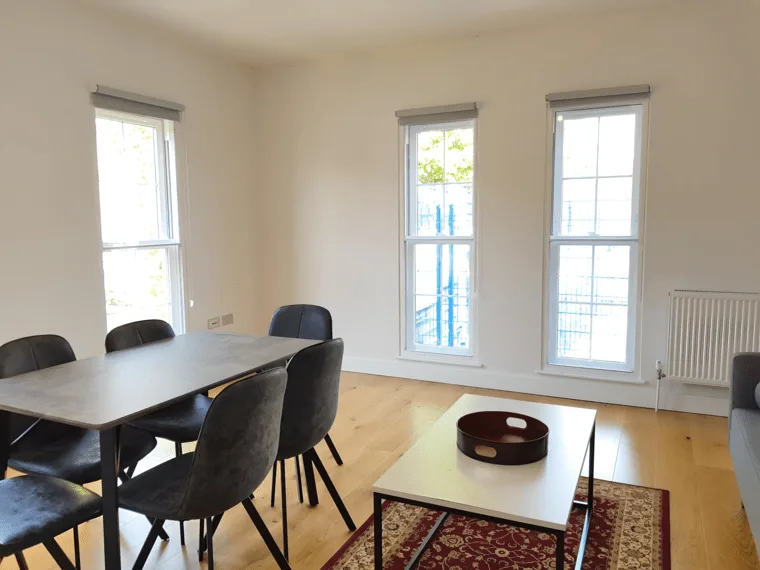
The Slimline Advantage: Maximum Silence, Zero Visual Impact
Our Slimline secondary glazing system was designed specifically for modern city apartments where aesthetics and acoustic performance must coexist. Here's what makes it different:
Ultra-Slim Profile
Total system depth of just 20–30mm from your existing window reveal. The anodised aluminium frame is only 12mm wide — thinner than a pencil. From across the room, the secondary panel is virtually invisible against your existing window. Your sightlines, light levels, and room proportions remain unchanged.
No External Changes
Installed on the inside of your existing windows, our system requires no planning permission and no consent from building management. The external façade is completely unaltered. This makes it the only viable acoustic solution for leasehold apartments, listed buildings, and managed residential blocks.
Broadband Protection
The 10.8mm laminated acoustic glass provides consistent attenuation across the full frequency spectrum — from construction bass at 63 Hz through to siren peaks at 3 kHz. No weak spots. No frequency bands where city noise leaks through. Measured Rw values of 42–46 dB across the broadband range.
Real-World City Performance
In a recent installation for a client in Shoreditch — a second-floor apartment overlooking a main road with three bars and a late-night venue — we measured the following: external weekend noise at 78 dB peak, reduced to 34 dB internal. The client reported being unable to hear street noise with the windows closed for the first time in four years of occupancy. That's the difference engineered acoustics makes.
20mm
System Depth
44 dB
Peak Reduction
1 Day
Installation Time
How It Works: Urban Noise to Urban Calm
Our process accounts for the unique challenges of apartment installations — access constraints, management approvals, and the need for minimal disruption to your daily routine.
Urban Noise Assessment
City noise is unpredictable — sirens at 3am, construction at 7am, bar crowds at midnight. We conduct a 24-hour noise profile of your property, identifying peak events, background levels, and the specific frequency mix unique to your location. This data drives every specification decision.
Slimline System Design
We design a secondary glazing system with a total depth of just 20–30mm. The slimline aluminium frames are finished to match your existing window colour and profile. From inside, the secondary panel is virtually invisible. From outside, your building's façade is completely unchanged — critical for modern apartment blocks with strict management rules.
Broadband Glass Specification
City noise spans the full frequency spectrum: construction rumble (low), traffic and voices (mid), and sirens and glass (high). We specify a laminated acoustic unit optimised for broadband attenuation — typically our 10.8mm asymmetric laminate — ensuring consistent reduction across all frequencies rather than leaving gaps at any particular band.
Discreet Installation & Verification
Installation is completed in a single day with minimal disruption. No scaffolding, no external works, no planning permission required. We verify performance with calibrated measurements and provide a certificate showing the achieved reduction at low, mid, and high frequencies.
Is This Solution Right for You?
You live in a London apartment near bars, restaurants, or nightlife venues
Sirens, construction, and street noise disrupt your sleep or work-from-home concentration
Your building management or lease prohibits external window modifications
You want acoustic improvement without losing natural light or altering room aesthetics
Your modern windows have slim frames that provide minimal sound insulation
You need a solution that can be installed in a single day without scaffolding
Request a Free Noise Survey
We'll visit your apartment, conduct a comprehensive noise assessment, and show you exactly how our Slimline system will fit your windows — with a detailed quote and no obligation. Evening and weekend appointments available.
Explore Related Solutions
Pricing Guide
Transparent pricing for all acoustic glazing tiers — see costs for apartments and townhouses.
Glass Specifications
Compare the acoustic performance of every glass type we specify — from 29dB to 50dB+.
Traffic Noise Solutions
Dedicated A-road and HGV noise reduction — different frequency profile, different engineering.
Aircraft Noise Solutions
High-frequency flight path noise from Heathrow and Gatwick — airtight seals are critical.
Secondary Glazing Guide
How acoustic secondary glazing works for period homes, listed buildings, and conservation areas.
Islington & Canonbury Guide
Tackling bus-route rumble and night-time noise in N1 Georgian terraces.
Frequently Asked Questions
Can secondary glazing block siren and nightlife noise?▾
Will secondary glazing work in a modern apartment with slim window frames?▾
Do I need building management permission?▾
How long does apartment installation take?▾
Will secondary glazing reduce drafts and heating bills too?▾
Sources & References
Government & Regulatory
- World Health Organization (WHO). "Environmental Noise Guidelines for the European Region". WHO Regional Office for Europe, 2018.Link
Provides evidence-based guidelines on the health impacts of environmental noise in urban settings and recommended exposure limits.
- Department for Environment, Food & Rural Affairs (Defra). "Noise Policy Statement for England (NPSE)". Gov.uk, 2010.Link
Outlines the UK government's policy on managing noise to promote health and quality of life, relevant to urban residential developments.
- HM Government. "Approved Document E: Resistance to the passage of sound". The Building Regulations 2010: Access to and use of buildings, Volume 1: Dwellings (Approved Document E), 2003.Link
Offers specific guidance on the noise insulation requirements for residential buildings in the UK.
Scientific & Technical
- D.J. Oldham, C.A. Egan, R.D. Cookson. "Sustainable acoustic glazing: The sound insulation performance of secondary glazing systems". Applied Acoustics, Volume 65, Issue 4, 2004.Link
Investigates the performance of different glazing configurations in reducing low-frequency urban noise, such as construction and traffic.
- J. Kastelein. "The acoustic performance of laminated glass in urban environments". Proceedings of the Institute of Acoustics, 2015.
A technical study on how laminated glass layers dampen specific frequency peaks, such as sirens and emergency vehicle noise.
Industry Standards
- British Standards Institution (BSI). "BS EN ISO 10140-2:2021: Acoustics. Laboratory measurement of sound insulation of building elements. Measurement of airborne sound insulation". BSI Standards Publication, 2021.Link
The primary British Standard for measuring the sound insulation performance of building elements, including secondary glazing.
- British Standards Institution (BSI). "BS 8233:2014 Guidance on sound insulation and noise reduction for buildings". BSI Standards Publication, 2014.Link
Provides comprehensive guidance on sound insulation and noise reduction for buildings, including criteria for residential apartment internal noise levels.
Citations generated with AI assistance. Please verify sources independently.