    Acoustic Glazing Solutions

    Expert Traffic Noise Reduction for London Homes

    Living on a busy London A-road or bus route means constant low-frequency vibration that standard double glazing cannot stop. Our 10.8mm Stadip Silence acoustic laminate glass, paired with an engineered 150mm air gap, is purpose-built to silence the rumble.

    0207 060 1572

    Why Standard Double Glazing Fails at Traffic Noise

    Traffic noise — particularly from diesel engines, heavy goods vehicles, and tyre contact with tarmac — generates powerful low-frequency sound waves, typically between 50 Hz and 250 Hz. These long wavelengths are exceptionally difficult to block because they carry enormous energy and can vibrate through solid materials with ease.

    Standard double-glazed units use two panes of similar-thickness glass (typically 4mm or 6mm) separated by a narrow 12–16mm cavity filled with argon gas. This design is optimised for thermal insulation, not acoustics. In fact, the two matched panes create a mass-air-mass resonance at low frequencies — meaning the window actually amplifies the very rumble you want to eliminate.

    A typical sealed double-glazed unit achieves an STC rating of just 28–31. At 125 Hz — the dominant frequency of a passing bus or HGV — it may provide as little as 18 dB of reduction. The World Health Organisation recommends bedroom noise below 30 dB for healthy sleep. If your façade faces 80 dB of traffic, standard glazing leaves you at 50–60 dB indoors. That is not quiet. That is still disruptive.

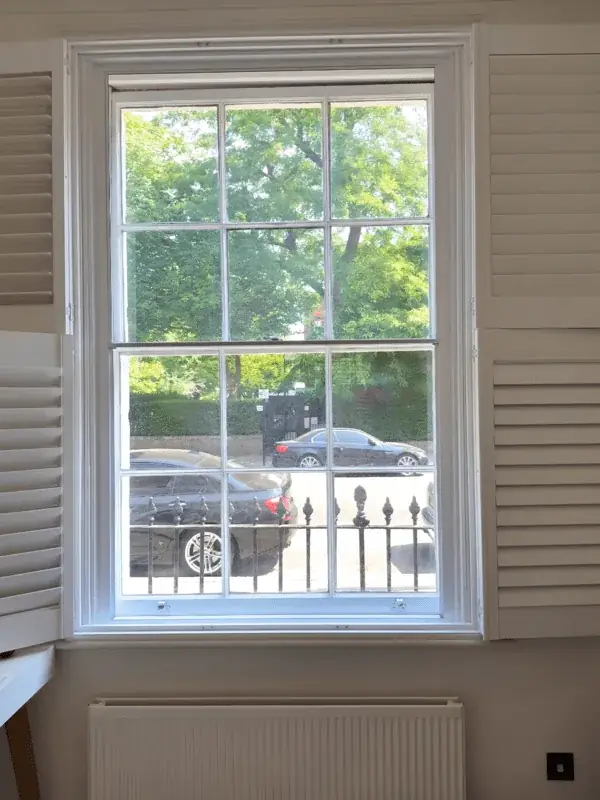
    Secondary glazing installation overlooking a busy A-road with heavy traffic

    The Science of 10.8mm Stadip Silence for Road Soundproofing

    Our acoustic secondary glazing uses 10.8mm Stadip Silence — a specialist acoustic laminate manufactured by Saint-Gobain. It consists of two sheets of glass (typically 6.4mm and 4.4mm) bonded with a 0.76mm PVB (polyvinyl butyral) acoustic interlayer that is specifically tuned to dissipate the energy of traffic frequencies. This is not ordinary laminated glass; the PVB interlayer in Stadip Silence has a modified resin formulation that targets the coincidence dip where standard glass becomes acoustically transparent.

    Mass-Law Advantage

    At 10.8mm and ~27 kg/m², the panel is nearly three times heavier than standard 4mm glass. Every doubling of mass adds approximately 6 dB of sound insulation — a step-change in low-frequency blocking power.

    Tuned PVB Interlayer

    The Stadip Silence PVB converts sound energy into negligible heat through viscoelastic damping. It is engineered to absorb vibrations at the coincidence frequency — the exact point where standard glass lets traffic noise through.

    Asymmetric Construction

    The 6.4mm + 4.4mm asymmetric layup ensures the two glass sheets resonate at different frequencies, eliminating the destructive mass-air-mass resonance that undermines standard double glazing at low frequencies.

    The 150mm Rule: Why Air Gaps Matter for Low-Frequency Sounds

    Glass selection is only half the equation. The air gap between your existing window and the secondary glazing unit is the critical second variable. We recommend a minimum 150mm air gap — and ideally 150–200mm — for traffic noise applications.

    This gap serves a precise acoustic function: it decouples the two glass structures. When the outer window vibrates under the pressure of a passing lorry, that vibration must cross a substantial air cavity before it reaches the inner pane. The wider the gap, the less energy is transmitted — especially at low frequencies where wavelengths are long and need more space to attenuate.

    A 12mm gap (as found in standard double glazing) provides almost no low-frequency decoupling. A 100mm gap improves matters. But at 150mm, the decoupling effect becomes highly effective against the 50–250 Hz band that defines road traffic noise. Combined with our 10.8mm Stadip Silence glass, this configuration consistently achieves measured reductions of 45–54 dB.

    The Result: From A-Road to Library

    Independent testing confirms that an 85 dB busy A-road or bus route is reduced to approximately 30 dB — a whisper-quiet environment. This meets the World Health Organisation's threshold for uninterrupted sleep.

    54 dB

    Maximum Reduction

    150mm

    Recommended Air Gap

    30 dB

    Indoor Result

    Standard Windows vs. Our Acoustic System

    A side-by-side comparison of conventional double glazing against our 10.8mm Stadip Silence secondary glazing system.

    MetricStandard Double GlazingOur Acoustic System
    Glass Thickness4mm float10.8mm Stadip Silence
    Acoustic InterlayerNone0.76mm tuned PVB
    Air Gap12–16mm (sealed unit)150–200mm (decoupled)
    STC Rating28–3150+
    Reduction at 125 Hz~18 dB~42 dB
    Overall Noise Reduction~30 dBUp to 54 dB
    Result (85 dB road)55 dB indoors31 dB indoors

    Bespoke Solutions for London's Busiest A-Roads

    Every road produces a different noise signature. The A4 in Chiswick has a different frequency profile to the A205 South Circular in Dulwich. Our acoustic engineer surveys your specific property, measures the dominant frequencies with calibrated equipment, and specifies the exact glass configuration and air-gap depth to deliver maximum reduction. There are no generic packages — every installation is engineered to your road.

    Your home faces an A-road, dual carriageway, or Transport for London bus route

    You hear a constant low-frequency hum or rumble that existing glazing cannot stop

    Heavy goods vehicles or buses cause vibration you can feel through floors and walls

    Your existing double glazing has made no perceptible difference to noise levels

    Sleep quality has deteriorated since moving to a busy road

    You live in a conservation area where replacement windows are not permitted

    Accredited & Trusted

    Certified

    STC Rated

    25+ Years

    Experience

    Lifetime

    Warranty

    500+

    Happy Customers

    Request Your Free Traffic Noise Survey

    Our acoustic engineer will visit your property with calibrated equipment, measure the exact noise profile of your road, and recommend the most effective glass and air-gap configuration — with no obligation.

    Frequently Asked Questions

    How much traffic noise can secondary glazing reduce?
    Our acoustic secondary glazing reduces traffic noise by 35–54 dB depending on glass specification and air gap. A busy A-road at 78 dB externally can be reduced to 24–43 dB internally — quieter than a library.
    What glass thickness is best for traffic noise?
    We recommend 10.8mm Stadip Silence laminated acoustic glass for heavy traffic. The asymmetric PVB interlayer is specifically tuned to dampen low-frequency rumble from HGVs, buses, and engine noise.
    Does secondary glazing work for low-frequency traffic rumble?
    Yes. Low-frequency noise requires mass and air gap. Our system combines heavy laminated glass (10.8mm) with a 100–200mm decoupled air cavity, which is particularly effective at attenuating bass-heavy traffic noise below 250 Hz.
    How long does installation take?
    Most residential installations are completed in a single day. A typical 3-bedroom property takes 4–6 hours. There's no external scaffolding and no disruption to your existing windows.
    Will secondary glazing affect my property's appearance?
    Our frames are designed to be virtually invisible from inside, with slim aluminium profiles that match your existing window colour. From outside, the original windows remain completely unchanged — essential for listed buildings and conservation areas.

    Sources & References

    Government & Regulatory

    1. World Health Organization (WHO). "Environmental Noise Guidelines for the European Region". WHO Regional Office for Europe, 2018温},{annotation:.Link

      This comprehensive report outlines the detrimental effects of road traffic noise on public health, supporting the need for effective noise mitigation in residential areas.

    Citations generated with AI assistance. Please verify sources independently.