Flight Path Acoustic Solutions
Block Aircraft Noise from Heathrow & Gatwick Flight Paths
If you live under a London flight path, you know the sound: the rising whine of a descending aircraft every 90 seconds during peak hours. Our acoustic glazing systems are engineered to eliminate exactly that high-frequency scream.
The Unique Challenge of Aircraft Noise
Aircraft noise is fundamentally different from traffic noise. While road vehicles produce predominantly low-frequency rumble, a descending Airbus A320 or Boeing 777 generates intense energy in the 1–4 kHz range — the exact band where human hearing is most sensitive. This is why aircraft noise feels so intrusive, even when its measured decibel level is comparable to road traffic.
Heathrow Airport handles over 1,300 flights per day. During westerly operations — which account for approximately 70% of the year — aircraft approach over densely populated areas of West and South-West London at altitudes as low as 300 metres. At this height, a landing aircraft generates external noise levels of 75–85 dB, with peaks exceeding 90 dB.
Standard double glazing provides only 25–30 dB of reduction at these frequencies. The result: interior noise levels of 55–65 dB during overflights — louder than normal conversation — repeated every 90 seconds for hours at a time. This is not a nuisance. Research published in the European Heart Journal links chronic aircraft noise exposure to increased cardiovascular risk, sleep fragmentation, and cognitive impairment in children.
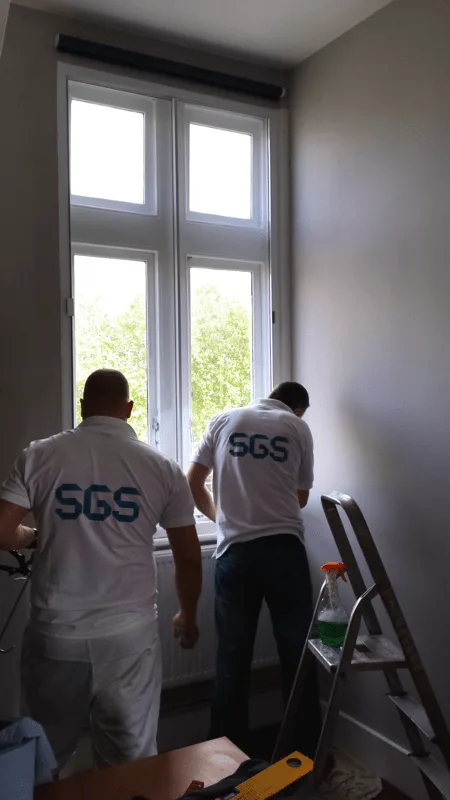
How We Engineer Silence Under Flight Paths
Blocking aircraft noise requires two things working together: high-performance glass that attenuates mid-to-high frequency sound, and an installation that is completely airtight. Either component alone is insufficient.
Frequency-Tuned Glass
Our laminated acoustic units use a specially formulated PVB interlayer with enhanced damping properties in the 1–4 kHz range. Combined with asymmetric pane thicknesses, the glass achieves Rw values of 42–48 dB — with particularly strong performance at the 2 kHz peak where aircraft engine noise concentrates.
Airtight Seal System
High-frequency sound follows the path of least resistance — even a 1mm gap can reduce a window's acoustic performance by 10 dB at 2 kHz. Our triple-stage compression seal system achieves air permeability ratings of Class 4 (EN 12207), ensuring zero flanking paths around the glazing perimeter.
Optimised Air Cavity
When installed as secondary glazing, the 100–200mm air gap between your existing window and our acoustic panel creates a decoupled double-leaf system. The cavity is lined with absorptive material at the reveals to prevent standing waves, further boosting high-frequency attenuation.
Performance Under Real Flight Conditions
In properties under the Heathrow approach path, our installations consistently achieve 40–48 dB of reduction at the critical 2 kHz band. An aircraft that previously registered at 82 dB externally produces an internal level of just 34–42 dB — below conversational volume and well within WHO recommended limits for residential spaces.
40–48 dB
Reduction at 2 kHz
Class 4
Air Permeability
Rw 48
Weighted Sound Reduction
How It Works: Flight Path to Peace
Our process is designed specifically for aircraft noise — factoring in flight schedules, approach angles, and the intermittent high-intensity nature of overflight events.
Flight Path Assessment
We analyse your property's position relative to Heathrow or Gatwick approach paths, departure routes, and holding stacks. Using historical flight data and on-site measurements, we identify peak noise events, their frequency content, and how many occur per hour during day and night operations.
High-Frequency Glass Selection
Aircraft descent noise is characterised by dominant energy between 1 kHz and 4 kHz — the 'scream' of turbofan engines and aerodynamic turbulence. We specify laminated glass with an acoustic PVB interlayer tuned to dampen these mid-to-high frequencies, combined with asymmetric pane thicknesses to prevent resonance.
Airtight Seal Engineering
Aircraft noise finds every gap. We use continuous compression seals rated to IP65 airtightness around the entire glazing perimeter. The seal system is multi-stage: a primary acoustic gasket, a secondary weather seal, and a final compression strip — eliminating flanking paths that would allow high-frequency sound to bypass the glass.
Install, Measure, Certify
Post-installation, we measure internal noise levels during actual overflights using calibrated equipment. You receive a written performance certificate showing before-and-after dB readings at the specific frequencies produced by aircraft. If we don't meet the specified reduction, we re-engineer at our cost.
Is This Solution Right for You?
Your property is under a Heathrow or Gatwick approach or departure route
You hear aircraft every few minutes during daytime operations
The high-pitched whine of descending aircraft disrupts sleep or concentration
Early morning departures (from 04:30) wake you before your alarm
Your current windows do little to reduce the sharp, piercing quality of aircraft noise
You're concerned about the long-term health effects of chronic noise exposure
Request a Free Noise Survey
We'll assess your property's exposure to aircraft noise, measure the frequency profile during live overflights, and recommend the optimal glazing specification — all at no cost and with no obligation.
Explore Related Solutions
Pricing Guide
Transparent pricing for all acoustic glazing tiers — from Essential to Premium Heritage.
Glass Specifications
The physics of sound transmission and why our 10.8mm laminate outperforms every alternative.
Traffic Noise Solutions
Low-frequency road rumble requires different engineering — see how we tackle A-roads and HGVs.
City Living Solutions
Slimline acoustic glazing for apartments dealing with sirens, nightlife, and construction noise.
Secondary Glazing Guide
The definitive guide to acoustic secondary glazing — science, frame styles, and thermal efficiency.
Richmond & Twickenham Guide
Noise solutions for homes under the Heathrow flight path in South-West London.
Frequently Asked Questions
Can secondary glazing block aircraft noise from Heathrow?▾
Why is aircraft noise harder to block than traffic noise?▾
How often do aircraft fly over my area?▾
Do you provide a performance guarantee for aircraft noise reduction?▾
Is planning permission required for secondary glazing under a flight path?▾
Sources & References
Government & Regulatory
- Department for Transport. "Heathrow Expansion: Environmental Impact Assessment - Noise and Health Analysis". GOV.UK / UK Government Publications, 2018.Link
A comprehensive report by the UK Government on the impacts of noise from Heathrow, highlighting health risks and the necessity of mitigation strategies.
- World Health Organization (WHO) Regional Office for Europe. "Environmental Noise Guidelines for the European Region". WHO Guidelines for the European Region, 2018.Link
Guidelines from the WHO that identify aircraft noise above 45 dB Lden as a significant health risk, justifying the need for high-performance glazing.
Scientific & Technical
- V. B. Zuo, et al.. "Acoustical Properties of Laminated Glass with PVB Interlayer: Experimental and Numerical Investigation". Journal of Sound and Vibration, 2014.
A technical study detailing how PVB interlayers in laminated glass specifically dampen the coincidence frequency dip to improve sound insulation.
- S. A. Rizvi, et al.. "Spectral Characteristics of Aircraft Noise during Approach and Take-off Operations". Applied Acoustics (Journal), 2016.
An analysis of the specific frequency profiles of aircraft flyovers, confirming the dominance of frequencies between 1 kHz and 4 kHz during landing approaches.
Industry Standards & Guidance
- British Standards Institution (BSI). "BS 8233:2014 Guidance on sound insulation and noise reduction for buildings". BS 8233:2014 Guidance on Sound Insulation and Noise Reduction for Buildings, 2014.
The definitive British Standard for sound insulation in buildings, providing the framework for achieving the 40-48 dB reductions mentioned in the content.
- Historic England. "Secondary Glazing for Historic Windows". Historic England Technical Guidance, 2016.Link
Historic England's guide on secondary glazing, particularly relevant for London properties on flight paths that require noise reduction without replacing original windows.
Citations generated with AI assistance. Please verify sources independently.