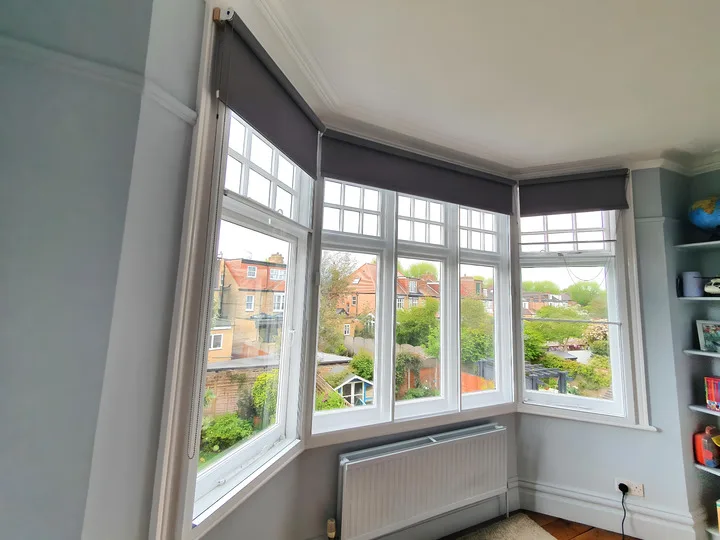

For London period homes, high-performance secondary glazing can deliver up to 54dB noise reduction, reduce heat loss through treated windows by up to 65%, and preserve original sash or casement windows. The recommended acoustic specification is 10.8mm Stadip Silence laminated glass, installed with a 100–150mm decoupled air gap.
This makes secondary glazing London homeowners' strongest practical option when replacement windows are unsuitable, restricted, or unlikely to address low-frequency traffic and aircraft noise effectively.
What You'll Learn
- What secondary glazing is and how it works.
- Why the air gap matters in period properties.
- How 10.8mm Stadip Silence glass reduces noise.
- The difference between secondary glazing and double glazing.
- Indicative London costs in 2026.
- Planning and listed-building considerations.
- Which solution to choose for traffic, aircraft, nightlife, or construction noise.
- Which London boroughs we cover.
What Is Secondary Glazing?
Secondary glazing is an independent window installed inside the existing window, usually within the internal reveal.
It does not replace the original sash, casement, bay, or timber window. Instead, it creates a second sealed barrier behind it.
The acoustic principle is called mass-air-mass separation:
- External sound reaches the original window.
- The remaining sound energy crosses the air cavity.
- The secondary pane absorbs and reflects additional sound.
- Airtight seals prevent sound leaking around the frame.
The air gap is critical. Standard double glazing often has a cavity of approximately 6–20mm. Acoustic secondary glazing can use a 100–150mm gap, which is substantially more effective against low-frequency noise such as buses, HGVs, trains, and aircraft.
Read our detailed guide to how secondary glazing works.
Why Secondary Glazing Works Well in London Period Homes
London has a high concentration of Victorian, Georgian, Edwardian, and early twentieth-century properties. These homes often have:
- Original single-glazed sash windows.
- Draughty or poorly sealed frames.
- Thin glazing that transmits road noise.
- Internal shutters or decorative reveals.
- Listed-building or conservation-area restrictions.
- Windows that owners want to preserve.
Replacing the original windows with modern double glazing can alter the building's character. It may also require planning consultation or Listed Building Consent.
Secondary glazing is installed internally and is designed to be reversible and non-destructive. The external appearance remains unchanged. This is why it is widely used in conservation areas and heritage properties.
However, consent requirements are not identical in every case. Historic England states that reversible secondary glazing will not generally require Listed Building Consent where it does not damage historic fabric. Local authorities can take a stricter view. Owners of listed buildings should obtain written advice from their borough's conservation or planning team before work begins.
The Recommended Acoustic Specification
10.8mm Stadip Silence laminated glass
Our highest-performance system uses 10.8mm Stadip Silence laminated glass from Saint-Gobain.
The glass consists of bonded layers with a specialist PVB acoustic interlayer. PVB means polyvinyl butyral. In simple terms, it is a flexible layer between sheets of glass that helps dampen vibration as sound passes through.
The specification is designed to improve performance across a broad range of frequencies. It is particularly relevant to London noise sources that standard glazing often fails to control.
100–150mm air gap
We normally specify a minimum air gap of 100mm, with 150mm preferred where the window reveal allows.
A larger cavity:
- Separates the two glazing systems more effectively.
- Reduces mass-air-mass resonance.
- Improves attenuation of low-frequency traffic rumble.
- Allows the original window to remain untouched.
- Provides additional thermal insulation.
The final result depends on the original window, frame condition, room construction, installation accuracy, and noise frequency. A quoted maximum is not a guaranteed result for every property.
Seals and frame design
Glass alone does not soundproof a room. The secondary frame must be accurately measured and properly sealed.
Our installations use bespoke frames, specialist compression seals, and installation tolerances designed to minimise acoustic leakage around the perimeter. This is important because even a small unsealed gap can reduce the effectiveness of the glazing system.

Expected Noise Reduction in London
A well-specified and correctly installed system can achieve approximately 45–50dB reduction in typical conditions, with up to 54dB possible in favourable installations.
A decibel reduction is not a percentage. Decibels use a logarithmic scale, so a 10dB change represents a substantial change in sound energy and perception.
| London noise source | Typical external level | Indicative internal level after secondary glazing* |
|---|---|---|
| Heavy A-road traffic | 80–85dB | Approximately 30–40dB |
| Bus route or HGVs | 75–82dB | Approximately 28–36dB |
| Urban street noise | 65–75dB | Approximately 24–35dB |
| Aircraft overhead | 85–90dB | Approximately 35–45dB |
| Railway or Overground line | 75–85dB | Approximately 30–40dB |
*Indicative values only. Actual results depend on the building, original window, seals, room position, and noise spectrum.
For a bedroom, reducing peak external noise to the low or mid-30dB range can make a material difference to sleep. The aim is not to promise absolute silence. The aim is to reduce intrusive peaks and make the room more usable.
For a more detailed explanation of sound levels, see our decibel guide.
Secondary Glazing vs Double Glazing
The two systems are not equivalent.
| Feature | Standard double glazing | Acoustic secondary glazing |
|---|---|---|
| Installation | Replaces the original window | Installed behind the existing window |
| Typical air gap | 6–20mm | 100–150mm |
| Typical acoustic performance | Approximately 25–30dB | Approximately 45–54dB with premium specification |
| Low-frequency traffic control | Limited to moderate | Stronger when correctly sealed |
| Original window preserved | No | Yes |
| Listed-building suitability | Often unsuitable | Usually the preferred approach |
| External appearance | Changes | Remains unchanged |
| Installation disruption | Higher | Lower; usually internal |
| Planning permission | May require advice or consent | Normally not required for internal work |
| Opening options | Depends on replacement design | Hinged, vertical sliding, or horizontal sliding |
Choose secondary glazing when:
- You own a listed or heritage property.
- Your original sash windows must remain.
- Traffic or aircraft noise is the main problem.
- You want a reversible installation.
- You need a large air gap for low-frequency attenuation.
- You want to minimise external building work.
Choose replacement double glazing when:
- The existing windows are beyond economic repair.
- Heritage restrictions do not apply.
- External appearance is not a concern.
- Thermal performance is the primary objective rather than maximum acoustic reduction.
For a side-by-side evaluation of window types, use our window comparison tool.
Thermal Benefits and U-Values
A U-value measures how readily heat passes through a building element. Lower is better.
A typical single-glazed window may have a U-value around 5.0 W/m²K. Adding well-designed secondary glazing with a substantial cavity can reduce the treated window's U-value to approximately 1.8 W/m²K, depending on the glass and frame configuration.
That represents up to 65% less heat loss through the treated window area. It does not mean a 65% reduction in the entire household energy bill, because walls, roofs, ventilation, doors, and heating controls also affect total consumption.
Additional benefits can include:
- Fewer cold draughts.
- Warmer internal glass surfaces.
- Reduced condensation risk.
- Improved comfort beside street-facing windows.
- Potential support for EPC improvement in rental properties.
Secondary Glazing London Costs in 2026
Prices vary according to window size, access, frame style, glass specification, and heritage requirements.
| Window type | Indicative installed cost with 10.8mm acoustic glass |
|---|---|
| Standard casement | £450–£680 |
| Victorian or Georgian sash | £520–£780 |
| Bay window section | £600–£900 |
| Large picture window | £720–£1,050 |
| Door panel | £800–£1,200 |
| Premium heritage system with timber subframe | £1,400–£1,900 |
Typical project budgets include:
- One-bedroom flat: £1,500–£3,600.
- Two-bedroom Victorian terrace: £2,500–£6,300.
- Three-bedroom home: £4,000–£9,000.
- Grade II listed property: approximately £5,400–£14,000, depending on window count and detailing.
See our full secondary glazing cost guide or London pricing guide.
All figures are indicative. A survey is required to account for uneven sash frames, bays, shutters, access, parking, and conservation requirements.
London Noise Sources We Treat
The correct specification depends on the noise rather than simply the postcode.
- Traffic and buses: Use a large air gap and acoustic laminated glass to target low-frequency engine and tyre noise. See our traffic noise solutions.
- Heathrow and Gatwick aircraft: Aircraft noise combines high sound levels with intermittent peaks. Airtight secondary glazing is usually more effective than basic inserts. See our aircraft noise solutions.
- Nightlife and sirens: Hinged units with strong perimeter seals can be suitable for bedrooms facing busy streets.
- Construction: Temporary or phased solutions may be appropriate where works are short-term.
- Rail and Overground routes: The air gap and glass mass should be selected for vibration and low-frequency events.

Borough Coverage
We install secondary glazing throughout London, including:
- Westminster
- Camden
- Kensington and Chelsea
- Fulham and Hammersmith
- Richmond
- Islington
- Hackney
- Wandsworth
- Lambeth
- Southwark
- Greenwich
- Ealing
- Hounslow
- Brent
- Barnet
- Enfield
- Croydon
- Lewisham
- Tower Hamlets
- City of London
We work with homeowners, landlords, offices, and commercial properties. Every installation is bespoke and completed by our own team without subcontractors.
Installation Process and Disruption
The process normally involves:
- Free noise survey: We assess the rooms, window condition, and dominant noise frequencies.
- Detailed measurement: Each unit is measured to suit the existing reveal and frame.
- Specification: We recommend glass thickness, air gap, and opening style.
- Manufacture: Frames are made to the survey dimensions.
- Internal installation: Units are fitted from inside the property.
- Final inspection: Seals, operation, and finish are checked.
Installation time varies. A standard unit may take a few hours, while a full period-home project can take one or more days. Most work is completed without scaffolding and with substantially less disruption than window replacement.

Frequently Asked Questions
Is secondary glazing worth it in London?
It is often worth considering when noise is preventing sleep, reducing comfort, or affecting home working. It is particularly suitable where original windows cannot be replaced.
Does secondary glazing stop all traffic noise?
No window system eliminates every sound. Secondary glazing can reduce traffic noise by approximately 45–54dB, but flanking transmission through walls, roofs, doors, vents, and floors may remain.
Does it require planning permission?
Internal secondary glazing normally does not require planning permission because it does not change the external appearance. Listed Building Consent can vary by property and borough. Confirm requirements with the relevant local authority.
Will it damage my original sash windows?
A correctly designed reversible system should not damage the original windows. The installation should avoid cutting historic timber, shutters, panelling, or decorative reveals.
Can secondary glazing be opened?
Yes. Vertical sliders suit sash windows. Horizontal sliders suit wide windows and bays. Hinged units generally provide the strongest seal and are useful for bedrooms or rooms requiring frequent cleaning access.
How long does secondary glazing last?
A professionally installed system can provide many years of service when seals, frames, and operating hardware are maintained. Soundproof My Window provides a 10-year performance guarantee.
Can it improve an EPC rating?
It can improve the thermal performance of treated windows and may contribute to a better EPC assessment. The actual rating depends on the entire building and should be confirmed by an accredited assessor.
Sources and References
- Soundproof My Window: Secondary Glazing London
- Soundproof My Window: Secondary Glazing Costs
- Soundproof My Window: Pricing
- Saint-Gobain Glass: STADIP and STADIP SILENCE
- Historic England: Modifying Historic Windows
- Historic England: Listed Building Consent Advice Note
- Kensington and Chelsea: Householders' Guide to Windows
Performance figures should be treated as system estimates, not universal guarantees. Laboratory ratings describe tested configurations. On-site performance depends on the complete window assembly and the building fabric.
Arrange a Free Noise Survey
If you are dealing with traffic, aircraft, sirens, nightlife, or construction noise, a survey is the most reliable starting point.
We can measure your existing noise levels, inspect your period windows, confirm the available air gap, and recommend a suitable specification. Book a free noise survey or use our acoustic calculator for an initial estimate.
People Also Ask
Related questions could not be generated at this time.
Frequently Asked Questions
FAQs could not be generated at this time.
Related Articles

Next Step
Book a Free Noise Survey
Get a tailored acoustic report and fixed quote for your property. No obligation, surveys across London within 5 working days.