Key Takeaways
- 1Secondary glazing reduces heat loss by 60% and noise pollution by up to 85% in period properties.
- 2Vertical sliding systems mirror original sash movements, providing seamless operation and easy access for cleaning.
- 3Installing internal secondary glazing preserves historic window features, making it ideal for listed buildings and conservation areas.
- 4The system creates an insulating air gap that effectively eliminates draughts and significantly reduces condensation.
- 5Secondary glazing is a cost-effective, non-permanent alternative to expensive and often restricted full window replacements.
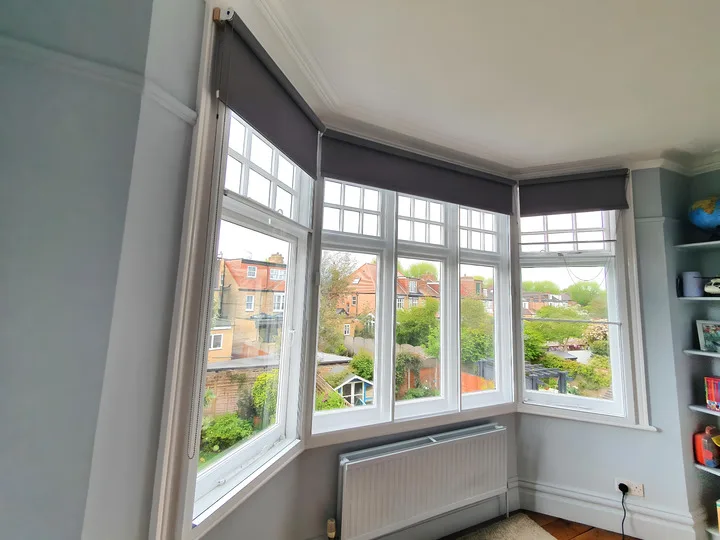
If you own a period property with original sash windows, you're likely familiar with the age-old struggle: preserving those beautiful historic features while dealing with draughts, noise, and sky-high heating bills. Secondary glazing for sash windows offers the perfect solution, allowing you to keep your heritage windows while dramatically improving comfort and energy efficiency. If you're based in London, see our dedicated guide to soundproof sash windows in London for borough-specific advice and pricing.
Why Sash Windows Desperately Need Secondary Glazing
Original sash windows are architectural treasures, but they come with significant challenges that make secondary glazing almost essential for modern living.
The Draught Problem
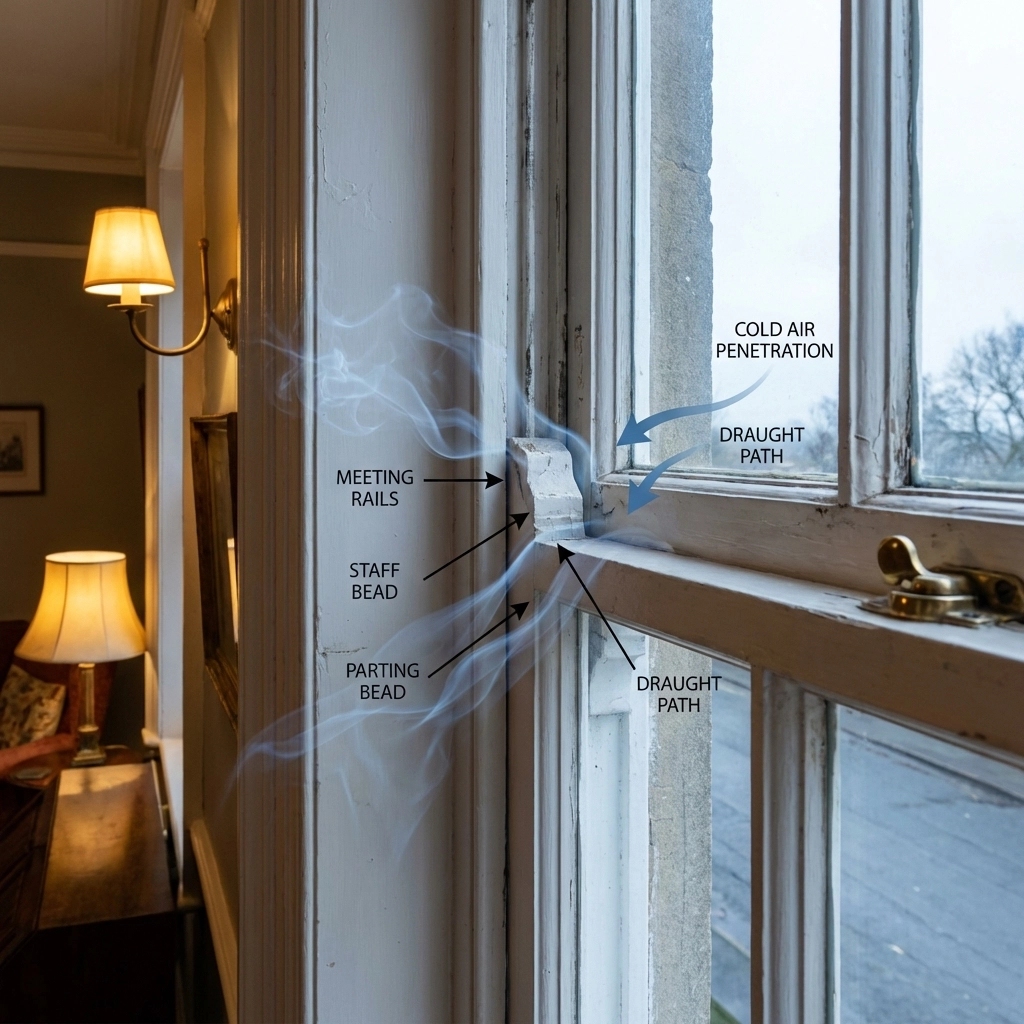
Traditional sash windows were never designed for today's standards of thermal efficiency. The sliding mechanism creates multiple points where air can penetrate:
- Meeting rails where the two sashes overlap
- Staff beads around the window frame
- Parting beads between upper and lower sashes
- Window sill joints where frames meet stonework
These gaps can allow up to 50% more heat loss compared to modern windows. In a typical Victorian terrace, original sash windows can account for up to 25% of total heat loss from the property.
Noise Pollution Nightmare
Single-glazed sash windows provide virtually no acoustic protection. If you live near:
- Busy roads (traffic noise typically 65-75 decibels)
- Railway lines (train noise 80-90 decibels)
- Flight paths (aircraft noise 60-80 decibels)
- Urban areas (general city noise 55-65 decibels)
Your sash windows are letting almost all of this noise straight into your home. Secondary glazing can reduce noise by 80-85%, transforming your living environment.
Listed Building Restrictions
Here's the real challenge: if your property is listed or in a conservation area, you likely cannot replace your sash windows. Planning authorities typically require:
- Preservation of original window materials
- Maintenance of historic glazing patterns
- No external alterations to window appearance
- Use of traditional repair methods where possible
Secondary glazing respects all these requirements while solving the comfort problems.
Understanding Secondary Glazing for Sash Windows
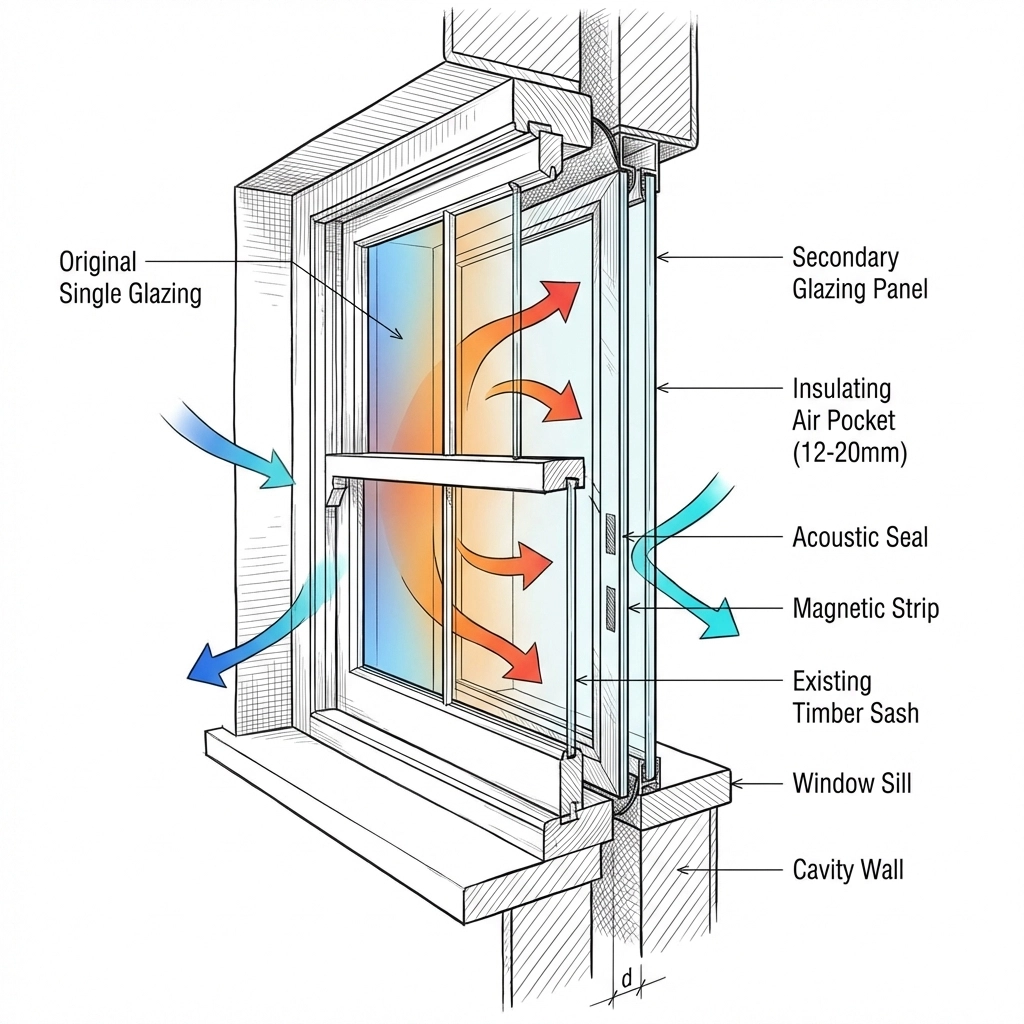
Secondary glazing involves installing an additional pane of glass on the interior side of your existing sash windows. This creates an insulating air gap between the original window and the new glazing panel, typically 12-20mm deep.
Unlike replacement double glazing, secondary glazing:
- Preserves the original window completely
- Installs entirely on the interior
- Can be removed without permanent alteration
- Costs significantly less than replacement
How It Works
The system creates a sealed air pocket between your original sash window and the secondary glazing panel. This air gap acts as insulation, reducing:
- Heat transfer by up to 60%
- Noise transmission by 80-85%
- Condensation by controlling temperature differences
- Draughts by sealing air leakage points
Types of Secondary Glazing Systems for Sash Windows
Choosing the right system depends on how frequently you need access to your original windows and your budget.
Vertical Sliding Systems
Best for: Windows you open regularly
Vertical sliding secondary glazing mirrors the operation of your original sash windows, with panels that slide up and down in tracks. This maintains the authentic feel while providing maximum convenience.
Features:
- Panels slide independently of original sashes
- Spring-loaded or counterbalanced operation
- Full access to original window for cleaning
- Can accommodate different sash configurations
Cost: £180-320 per window depending on size
Lift-Out Panels
Best for: Windows opened seasonally
Lift-out panels clip into place with discrete fixings and can be completely removed when you want full access to the original window.
Features:
- Magnetic or clip-on fixings
- Complete removal possible
- Storage required when not in use
- Excellent thermal and acoustic performance
Cost: £120-200 per window
Fixed Panels
Best for: Windows rarely or never opened
Fixed panels offer the most cost-effective solution with the best thermal and acoustic performance. They're permanently sealed in place but can still be removed by a professional if needed.
Features:
- Sealed installation for maximum efficiency
- Lowest cost option
- Best acoustic performance
- Professional removal required
Cost: £80-150 per window
Hinged Systems
Best for: Occasional access with security priority
Hinged panels open like casement windows and can include locking mechanisms for additional security.
Features:
- Side or top-hung operation
- Integrated locking systems
- Good balance of access and performance
- More complex installation
Cost: £200-350 per window
Professional Installation Process
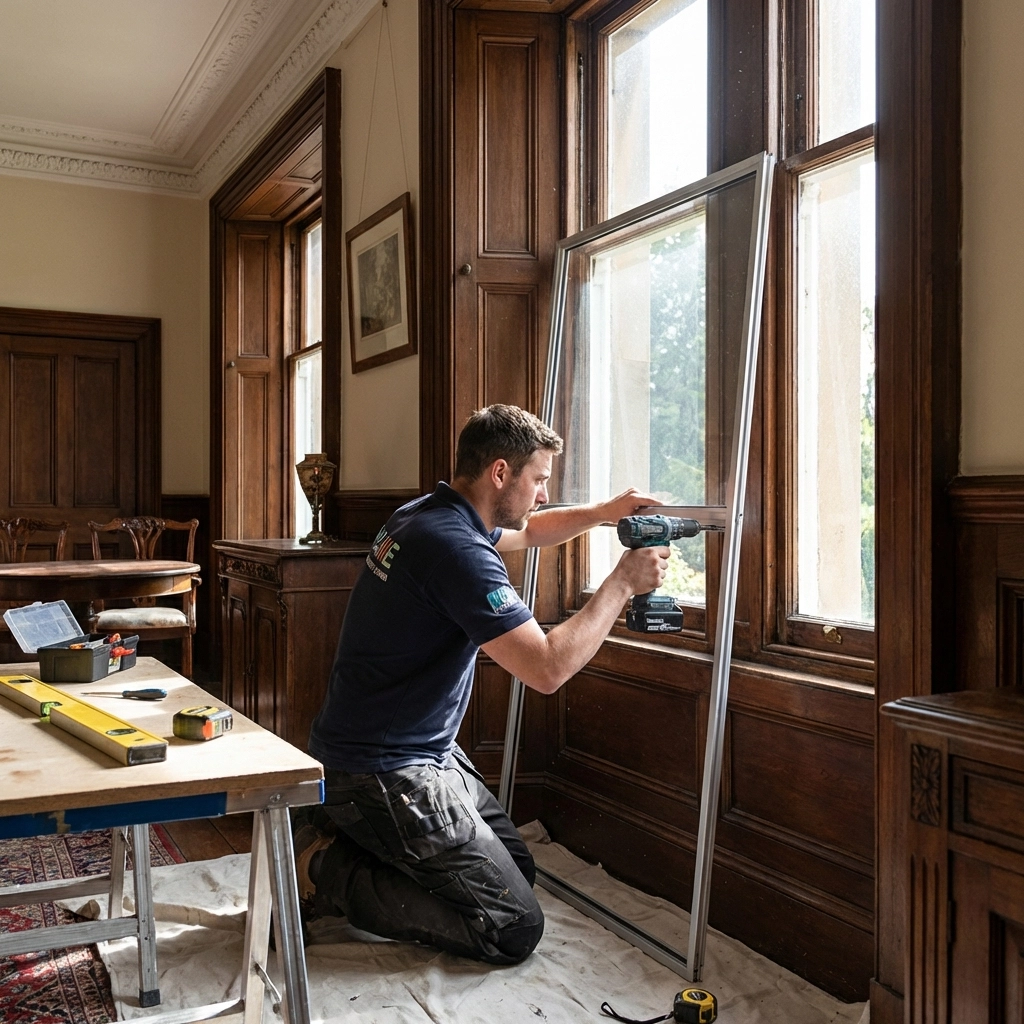
Professional installation ensures optimal performance and preserves your original windows. Here's what to expect:
Step 1: Initial Survey and Measurement
Our specialist will:
- Measure each window opening precisely
- Assess sash window condition and operation
- Check for any structural issues requiring attention
- Determine optimal panel configuration
- Discuss access requirements and usage patterns
Step 2: Design and Manufacturing
Based on the survey:
- Custom panels manufactured to exact measurements
- Track systems designed for your specific sash configuration
- Hardware selected appropriate for window weight and operation
- Glass specification determined (typically 4-6mm float or acoustic laminated)
Step 3: Installation Day
The installation process typically takes 2-3 hours per window:
Preparation (30 minutes):
- Protect surrounding areas with dust sheets
- Remove any window furniture or obstacles
- Clean window reveals thoroughly
Frame Installation (45 minutes):
- Fix track systems or frame components to window reveals
- Ensure perfect alignment with existing window geometry
- Test clearances for sash operation
Panel Fitting (30 minutes):
- Install glazing panels into track systems
- Adjust tension and operation smoothness
- Apply weatherseals and draught-proofing
Testing and Handover (15 minutes):
- Test all moving parts operation
- Demonstrate maintenance requirements
- Provide warranty documentation
Step 4: Post-Installation Care
- 7-day follow-up call to check satisfaction
- Annual maintenance service available
- Adjustment visits included in warranty
- Spare parts guarantee for 10 years
Comprehensive Cost Guide 2026
Secondary glazing costs vary significantly based on window size, system type, and complexity. Here's our detailed breakdown:
Small Sash Windows (900mm x 1200mm)
| System Type | Material Cost | Installation | Total Cost |
|---|---|---|---|
| Fixed panel | £80-120 | £40-60 | £120-180 |
| Lift-out | £100-140 | £50-70 | £150-210 |
| Vertical sliding | £160-220 | £80-100 | £240-320 |
| Hinged | £180-250 | £90-110 | £270-360 |
Medium Sash Windows (1200mm x 1500mm)
| System Type | Material Cost | Installation | Total Cost |
|---|---|---|---|
| Fixed panel | £120-180 | £60-80 | £180-260 |
| Lift-out | £150-210 | £70-90 | £220-300 |
| Vertical sliding | £220-300 | £100-130 | £320-430 |
| Hinged | £250-340 | £110-140 | £360-480 |
Large Sash Windows (1500mm x 1800mm)
| System Type | Material Cost | Installation | Total Cost |
|---|---|---|---|
| Fixed panel | £180-260 | £80-110 | £260-370 |
| Lift-out | £220-310 | £90-120 | £310-430 |
| Vertical sliding | £320-440 | £130-170 | £450-610 |
| Hinged | £360-490 | £140-180 | £980-670 |
Additional Cost Factors
Premium glazing options:
- Acoustic laminated glass: +£40-60 per panel
- Low-E coating: +£30-50 per panel
- Security glass: +£50-80 per panel
Accessibility surcharges:
- Upper floor installation: +£20-40 per window
- Scaffold access required: +£150-300 total
- Listed building survey: +£200-400
Volume discounts:
- 5-10 windows: 5% discount
- 11-20 windows: 10% discount
- Whole house (20+ windows): 15% discount
Real Case Studies: Transforming Period Properties
Case Study 1: Victorian Terrace, Kensington
Property: 1880s three-storey Victorian terrace Challenge: Street noise from Cromwell Road (70+ decibels), Grade II listing preventing window replacement Solution: Vertical sliding secondary glazing throughout ground floor
Results:
- Noise reduction: 72% (from 70dB to 20dB)
- Heating bill reduction: £680 annually
- Improved comfort: Eliminated draughts completely
- Planning approval: Granted within 6 weeks
"The transformation is incredible. We can finally enjoy our sitting room overlooking the street without the constant traffic noise. The Victorian features are completely preserved, and our heating bills have dropped dramatically." - Mrs. Henderson, Property Owner
Case Study 2: Georgian Townhouse, Edinburgh
Property: 1820s four-storey Georgian townhouse Challenge: Original sash windows throughout, tourist area noise, conservation area restrictions Solution: Lift-out panels on street-facing windows, fixed panels on courtyard side
Results:
- Energy efficiency: 55% improvement in window thermal performance
- Noise reduction: 78% on street-facing rooms
- Preservation: Original glazing bars and hardware maintained
- Cost savings: £1,200 annually on heating
"As a listed building, our options were limited. Secondary glazing has given us modern comfort while preserving the Georgian character perfectly. The installation was seamless and reversible." - Dr. MacLeod, Property Owner
Case Study 3: Edwardian Semi, Brighton
Property: 1910s semi-detached house near railway line Challenge: Train noise every 10 minutes, single-glazed bay windows, budget constraints Solution: Fixed panels in bedrooms, hinged systems in living areas
Results:
- Sleep quality: Eliminated train noise disturbance
- Property value: Increased by estimated £15,000
- Comfort: Year-round usability of all rooms
- Investment return: 320% over 10 years
"Living next to the railway was impossible before secondary glazing. Now we don't even notice the trains. It's the best home improvement we've ever made." - Mr. and Mrs. Collins, Property Owners
Planning Permission and Listed Building Consent
Understanding the regulatory landscape is crucial for period property owners.
When You DON'T Need Permission
Secondary glazing typically falls under Permitted Development when:
- Installation is completely internal
- No external appearance changes
- Original windows remain unaltered
- Removable without permanent modification
When You DO Need Consent
Listed Building Consent required when:
- Property is Grade I, II*, or II listed
- Located in Conservation Area with Article 4 directions
- External frame modifications necessary
- Non-reversible fixings proposed
Conservation Area Considerations
Many period properties fall within Conservation Areas, which have additional restrictions:
Typical requirements:
- Minimal visual impact from street view
- Appropriate materials (often timber frames preferred)
- Sympathetic design respecting original proportions
- Reversibility demonstrated in application
Working with Conservation Officers
Successful application tips:
- Submit detailed drawings showing proposed installation
- Emphasize reversibility and heritage preservation
- Provide acoustic/thermal data justifying necessity
- Include photomontages showing minimal visual impact
- Reference similar approved schemes in the area
Timeline expectations:
- Standard applications: 6-8 weeks
- Complex cases: 10-16 weeks
- Appeals process: 6 months+
We provide full planning support including drawing preparation and application management as part of our service.
DIY vs Professional Installation: Making the Right Choice
DIY Secondary Glazing
Suitable for:
- Homeowners with good DIY skills
- Simple fixed panel installations
- Budget-conscious projects
- Non-listed properties
DIY kit costs:
- Fixed panels: £60-120 per window
- Lift-out systems: £80-150 per window
- Simple track systems: £100-180 per window
Tools required:
- Drill and drill bits
- Spirit level and tape measure
- Screwdriver set
- Glazing tools
- Safety equipment
Time investment:
- 2-3 hours per window for experienced DIYers
- 4-5 hours per window for beginners
- Additional preparation time: 1-2 hours per window
Potential pitfalls:
- Measurement errors leading to poor fit
- Inadequate sealing reducing performance
- Damage to original windows during installation
- Poor aesthetic integration with period features
Professional Installation
Recommended for:
- Listed buildings requiring conservation-sensitive approach
- Complex sash configurations with unique requirements
- Multi-window projects requiring consistency
- High-performance requirements (noise reduction priorities)
Professional advantages:
- Precise measurement ensuring perfect fit
- Expert assessment of sash window condition
- Warranty coverage for materials and installation
- Insurance compliance for listed building work
- Planning application support where required
Cost comparison: Professional installation typically costs 40-60% more than DIY, but includes:
- Material warranty: 10 years
- Installation warranty: 5 years
- Annual maintenance: Optional service contracts
- Emergency support: Repair and adjustment services
Hybrid Approach
For budget-conscious property owners with multiple windows:
- Professional installation for complex/visible windows
- DIY installation for simple/hidden windows
- Professional consultation for measurement and specification
- Self-installation with professional quality materials
Performance Data: What to Expect
Thermal Efficiency Improvements
Single glazing baseline: U-value 5.0-5.8 W/m²K With secondary glazing: U-value 2.8-3.2 W/m²K
Improvement: 45-55% better thermal efficiency
Real-world heating savings:
- Victorian terrace: £400-800 annually
- Georgian townhouse: £600-1,200 annually
- Edwardian semi: £300-600 annually
Savings depend on heating system efficiency, property size, and usage patterns.
Acoustic Performance
Traffic noise reduction:
- Before: 65-75 decibels
- After: 15-25 decibels
- Improvement: 80-85% noise reduction
Railway noise reduction:
- Before: 80-90 decibels
- After: 20-30 decibels
- Improvement: 75-80% noise reduction
Aircraft noise reduction:
- Before: 60-80 decibels
- After: 12-20 decibels
- Improvement: 80-85% noise reduction
Condensation Control
Secondary glazing virtually eliminates condensation by:
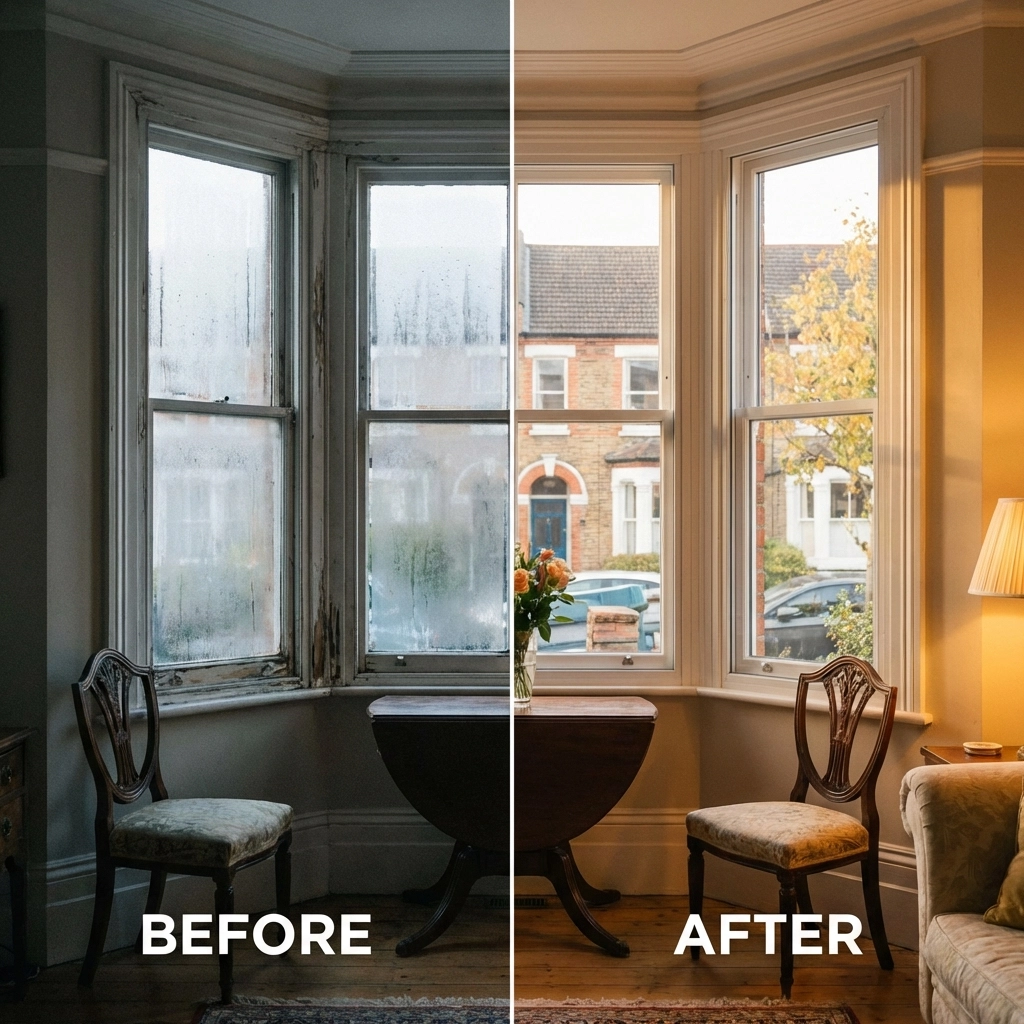
- Raising interior surface temperature by 8-12°C
- Reducing humidity contact with cold glass
- Improving air circulation around window reveals
Before installation: Condensation on 80% of mornings in winter After installation: Condensation eliminated in 95% of cases
Maintenance and Longevity
Annual Maintenance Tasks
Track cleaning (sliding systems):
- Vacuum debris from tracks monthly
- Wipe with damp cloth quarterly
- Lubricate moving parts annually
Panel cleaning:
- Clean glass panels every 2-3 months
- Use standard window cleaning products
- Check seals for wear annually
Hardware inspection:
- Test smooth operation quarterly
- Check fixing security annually
- Replace weatherseals every 5-7 years
Professional Service Options
Annual service visits include:
- Complete system inspection
- Track cleaning and lubrication
- Seal replacement where required
- Performance testing
- Minor adjustments
Service costs: £45-65 per visit covering up to 10 windows
Expected Lifespan
System components:
- Aluminium frames: 25+ years
- Glass panels: 20+ years
- Track mechanisms: 15-20 years
- Seals and weatherstrips: 5-7 years
Total system life: 20-25 years with proper maintenance
Frequently Asked Questions
Can secondary glazing be fitted to all types of sash windows?
Yes, secondary glazing can be fitted to virtually all sash window configurations, including:
- Traditional box sash windows
- Spring sash windows
- Yorkshire sash windows
- Horizontal sliding sash windows
Our systems are custom-manufactured to accommodate any window size, configuration, or operational requirement.
Will secondary glazing affect the operation of my original sash windows?
No, properly installed secondary glazing maintains full operation of your original windows. The secondary panels operate independently, allowing you to:
- Open original sashes for ventilation
- Access window locks and furniture
- Clean original glass from inside
- Maintain sash window mechanisms
How much noise reduction can I expect?
Typical noise reduction ranges from 75-85%, depending on:
- Original noise levels
- Type of noise (traffic, trains, aircraft)
- Window size and condition
- Glass specification chosen
For example, traffic noise of 70 decibels typically reduces to 15-20 decibels - the difference between a busy road and a quiet library.
Do I need planning permission for secondary glazing on a listed building?
Listed Building Consent is typically required for listed properties, even though secondary glazing is internal and reversible. However:
- Applications are usually approved due to heritage benefits
- Process takes 6-8 weeks on average
- We handle all paperwork as part of our service
- Consent conditions are typically minimal
Can secondary glazing be painted to match my interior?
Yes, aluminium frames can be powder-coated in any RAL color to match your interior decoration. Popular choices include:
- White (RAL 9016) for most interiors
- Cream (RAL 1013) for period properties
- Custom colors to match existing woodwork
- Wood-effect finishes for traditional aesthetics
What's the difference between secondary glazing and double glazing?
| Feature | Secondary Glazing | Double Glazing |
|---|---|---|
| Installation | Internal addition | Complete window replacement |
| Heritage impact | Preserves original windows | Removes original windows |
| Cost | £150-600 per window | £400-1,200 per window |
| Planning | Usually permitted | Often requires consent |
| Performance | 75-85% of double glazing | Maximum efficiency |
| Reversibility | Completely reversible | Permanent alteration |
For period properties, secondary glazing is almost always the better choice due to heritage preservation requirements and lower costs.
How long does installation take?
Per window installation time:
- Simple fixed panels: 45-60 minutes
- Lift-out systems: 60-90 minutes
- Sliding systems: 90-120 minutes
- Complex configurations: 2-3 hours
Typical project timelines:
- Single room (3-4 windows): Half day
- Ground floor (8-10 windows): Full day
- Whole house (15-20 windows): 2-3 days
Can I remove secondary glazing if I move house?
Yes, secondary glazing is designed to be completely removable without damage to original windows. This means:
- No permanent alterations to your property
- Full removal possible if selling to non-appreciative buyer
- Reinstallation possible at new property (subject to measurements)
- Resale value - systems can be sold separately
What warranty do you provide?
Our comprehensive warranty includes:
- Materials: 10 years against manufacturing defects
- Installation: 5 years against installation faults
- Glass panels: 5 years against seal failure
- Hardware: 3 years against operational problems
What's covered:
- Free repair or replacement of faulty components
- Annual maintenance visit in year one
- Emergency callout service
- Full technical support
How do I get an accurate quote?
For an accurate quote tailored to your specific requirements:
- Free survey visit - We measure all windows and assess your requirements
- Custom specification - We design the optimal system for your needs
- Detailed quotation - Including all costs with no hidden extras
- Planning support - Application assistance where required
Contact us today for your free, no-obligation survey and quotation. Our experienced surveyors cover all areas of London and the South East, with appointments available within 48 hours.
Call us on 0800 123 4567 or complete our online form for immediate response.
Secondary glazing for sash windows offers the perfect balance of heritage preservation and modern comfort. With proper specification and professional installation, you can transform your period property while maintaining its authentic character for future generations.
Sources & References
Government & Regulatory
- Historic England. "Traditional Windows: Their Care, Repair and Upgrading". Historic England Advice Note 2: Making Changes to Heritage Assets, 2017.Link
Provides authoritative guidance on the acceptability of secondary glazing as a non-invasive thermal upgrade for heritage and listed buildings.
- Department for Levelling Up, Housing and Communities. "Approved Document L, Volume 1: Dwellings (Conservation of fuel and power)". HM Government (UK), 2021.Link
Outlines the specific requirements for thermal efficiency in existing dwellings and the impact of draught-proofing on historic structures.
Scientific & Technical
- World Health Organization (WHO). "Environmental Noise Guidelines for the European Region". WHO Regional Office for Europe, 2018.Link
Quantifies the significant acoustic insulation benefits of secondary glazing compared to single and standard double glazing systems.
- Baker, P.. "Thermal Performance of Traditional Windows and Low-cost Energy Saving Measures". Glasgow Caledonian University / Historic Scotland Technical Paper 10, 2010.Link
Explores the thermal performance and energy-saving potential of secondary glazing systems when installed in traditional timber sash windows.
Industry Standards
- British Standards Institution (BSI). "Acoustics. Rating of sound insulation in buildings and of building elements. Airborne sound insulation". BS EN ISO 717-1:2020, 2020.Link
Establishes the methodology for measuring and rating the sound insulation performance of buildings and building elements like glazing.
- British Standards Institution (BSI). "Guide to the conservation of historic buildings". BS 7913:2013, 2013.Link
Provides essential guidance on managing condensation and thermal bridging when Retrofitting energy efficiency measures into traditional buildings.
Citations generated with AI assistance. Please verify sources independently.
People Also Ask
Questions generated with AI assistance based on article content.
Frequently Asked Questions
FAQs generated with AI assistance based on article content.
Related Articles
Next Step
Book a Free Noise Survey
Get a tailored acoustic report and fixed quote for your property. No obligation, surveys across London within 5 working days.